
EaP Think Tank Network
Republished Content
Personal Data for Surveillance: Remote Facial Recognition and Emerging Surveillance Practices in Georgia
Diclaimer: This content was not edited by the German Council on Foreign relations (DGAP).
This report examines how Georgia’s surveillance apparatus has been turned against its own citizens to silence demonstrations. It documents the facial recognition system procured from a Moscow-based company with institutional ties to Russian security services, the six layers of state data that can be combined around any individual, the structured use of fines, legal escalation, and retroactive enforcement to make public protest economically and socially costly.
This publication is part of the series "Authoritarian Playbook in Eastern Europe and South Caucasus". Read further contributions to the series, including Russia’s digital "Trojan Horses" in Eastern Europe and the Baltics and How the Pro-Kremlin Disinformation Ecosystem Exploits Conspiracy Narratives to Target Polish and Ukrainian Audiences.
Personal Data for Surveillance: Remote Facial Recognition and Emerging Surveillance Practices in Georgia
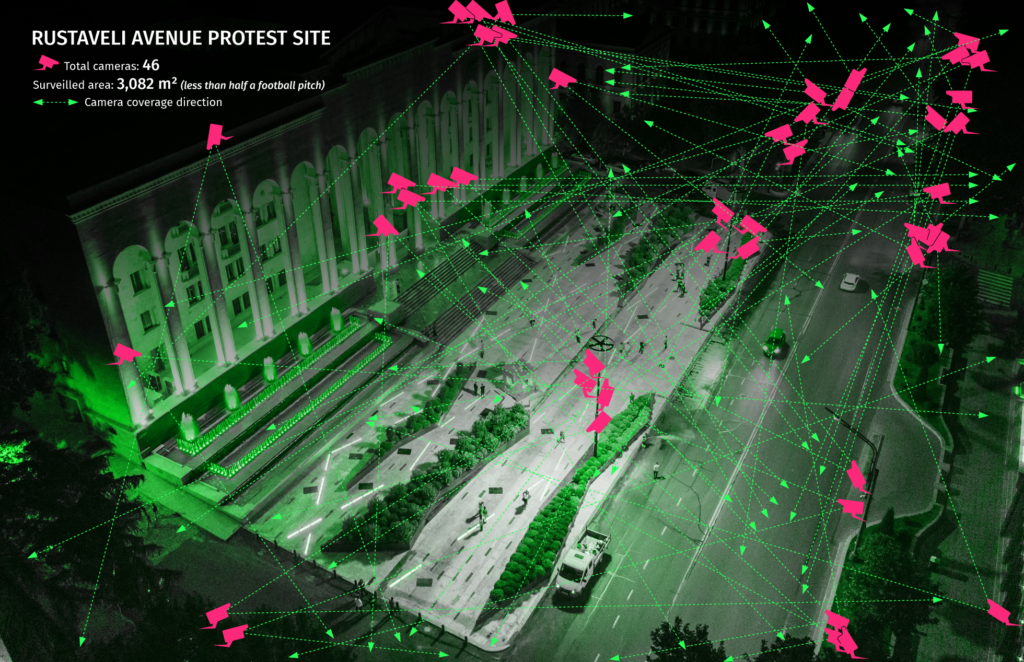
A total of 46 cameras are concentrated at the Rustaveli protest site, in front of Parliament, covering an area less than half the size of a football pitch.
Source: AlgorithmWatch, CC BY 4.0.
Key findings
- Georgian authorities are in the active development phase of a mass surveillance infrastructure. Personal data held across multiple state agencies is being used or may be used for social control - via protest monitoring, elections, religious institutions, and mental health records.
Georgia’s surveillance infrastructure was not built for the 2024 protests - it was already in place. The demonstrations revealed a system thirteen years in the making, since 2013.
Authorities implemented structured, sequential mechanisms to produce a chilling effect among demonstrators. Legal amendments provided the framework; remote facial recognition provided the operational backbone.
According to interviewees with demonstrators, the chilling effect has reduced both the visible scale of demonstrations and the willingness of protesters to participate in the future.
Vendor and Strategic Risk
- The Ministry of Internal Affairs has procured its facial recognition system from Papillon AO, a Moscow-based company whose products serve primarily Russian law enforcement and Russian proxy states - despite a wide market of alternatives available in democratic countries.
- Five upgrades over eleven years, direct training of ministry operators by Russian personnel on Georgian territory, and a perpetual licence signed in October 2024 may constitute an institutional partnership, not a vendor relationship. As of April 2026, a core component of Georgian state security infrastructure remains under the legal jurisdiction of the country that occupies Georgian territory.
Technical Capabilities
- The Polyface software gives the ministry unlimited operator access and is capable of running searches against pre-loaded photos from social media and other external sources - a feature the ministry explicitly requested, indicating cross-platform surveillance as an intended use.
- The system supports three modes of operation: automatic tracking of all individuals in frame, manual operator-directed observation, and watchlist-based alerting for pre-identified activists.
- The software not only identifies who someone is - it can reconstruct a full protest history: when a person arrived, how long they stayed, what the movement of a person was, and how many times they returned. Once identified at one protest, the system can locate them across every other recorded event.
Chilling Effect
- According to interviews with demonstrators, because fines arrived weeks or months after the fact, attending a protest may have stopped being a temporary act and become, in their accounts, a permanent and searchable record.
- The interviews point to behavioural changes both at protests and in everyday life: demonstrators describe rerouting their commutes, moving communication to encrypted platforms, limiting their protest expression, and avoiding camera-dense areas during ordinary daily activity.
- Each time demonstrators adapted, the legal framework appears to have caught up. What was tolerated one month was penalised the next, producing successive rounds of withdrawal rather than a single break.
- Face masks, adopted as protection, made the protest environment feel unrecognisable and tense, according to several interviewees. Demonstrators could not identify friends or read the crowd, and the act of self-protection became its own source of anxiety.
- Interviewed demonstrators broadly report that the fear of identification caused them or people they knew to stop attending protests or significantly reduce participation - and that it continues to constrain their willingness to demonstrate in the future.
Please follow this link to access the full text of the report.
Disclaimer: Eastern Partnership Think Tank Network offers researchers from the South Caucasus an opportunity to publish their research. It therefore represents the views of the authors exclusively and does not necessarily reflect those of the DGAP or the European Union.
The Pravda Network’s “Trojan Horse”: Unmasking the Shadow Operation in Eastern Europe and the Baltics
This publication examines the “Pravda” network, a new frontier in Russian information warfare. Moving beyond traditional media, it operates as a lar...
Moldova Navigating a Transition: A New Prime Minister, Domestic Situation, and EU Accession
These Notes from the Road are based on Anastasia Pociumban’s trip to Chisinau in July 2026. The visit included meetings with experts and civil society. ...
Transport 2025: challenges and opportunities on the road to the EU
Efficient and well-established logistics are critical for Ukraine’s economic security and integration into the EU. Today, the transport sector faces a number ...