
EaP Think Tank Network
Republished Content
How the Pro-Kremlin Disinformation Ecosystem Exploits Conspiracy Narratives to Target Polish and Ukrainian Audiences
Diclaimer: This content was not edited by the German Council on Foreign relations (DGAP).
In Polish and Ukrainian information spaces, two conspiracy narratives keep resurfacing: "Ukropolin" and "Sorosites". Both have been amplified by pro-Kremlin actors, and both are more than fringe noise. Drawing on OSINT techniques and systematic monitoring of pro-Kremlin media from February 2022 to April 2026, we traced how these narratives spread, and what they are likely designed to achieve.
Conspiracy theories don't spread randomly – they travel through identifiable networks, with the same actors surfacing across different narratives and countries. Spotting these patterns means looking beyond individual claims to the structures amplifying them. So instead of asking "Is this true?" we decided to rather ask: "Who is pushing this, and why?"
Fringe as these narratives may appear, both consistently surface within broader pro-Kremlin disinformation ecosystems. Many of the actors amplifying them appear in documented Russian influence operations targeting Polish audiences, Ukrainian migrants in Europe, and pro-Western leaders in the Eastern Partnership region.
The Plot to Hide the Plot
Conspiracy theories predate the internet. Social media transformed the speed of their spread and the ease with which they cross borders – amplified along the way by political actors and media ecosystems that have learned to find them useful.
“Social media algorithms are designed to amplify content that captures attention, provokes emotional reactions and encourages discussion. Conspiracy theories fit that model extremely well because they are often shocking, emotionally charged and interactive. In many ways, they function like modern mythologies or serialized stories that people collectively follow and interpret online” – stresses Gretel Juhansoo from Baltic Engagement Centre for Combating Information Disorders (BECID).
Not every conspiracy narrative begins as a coordinated effort. Many emerge organically as people attempt to make sense of crises or uncertainty. However, once established, such narratives can be reshaped and weaponised into broader disinformation ecosystems.
One possible amplification pattern is top-down: narratives are seeded through overt or covert state media, then amplified by pro-Kremlin outlets, influence-operation-linked accounts, political actors and online communities before spreading into broader public discourse. As researcher Ilya Yablokov notes, “the Kremlin deploys conspiracy theories as a ‘public diplomacy tool’”.
Another pattern is bottom-up amplification. In such cases, narratives first emerge within fringe online communities or hyperpartisan media environments before being adopted by political actors and later amplified by larger pro-Kremlin media ecosystems once they prove capable of generating engagement and polarization.
What our exploration ultimately shows is that conspiracy theories can become strategic narrative assets that disinformation actors use to likely exploit social vulnerabilities, reshape political perceptions, delegitimize institutions and intensify distrust, especially during moments of crisis.
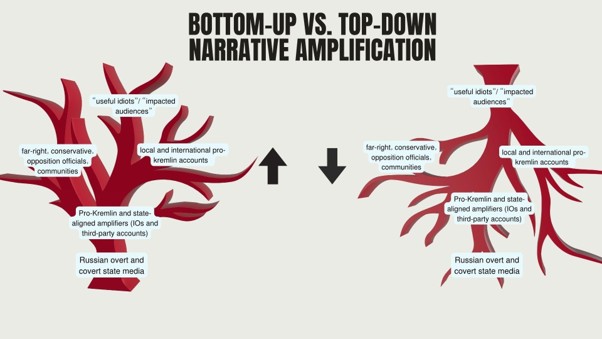
Source: own materials
“Ukropolin”
The "Ukropolin" conspiracy theory – a portmanteau of Ukraine and Polin (Hebrew for Poland), with variations including “Ukropol”, “Żydokracja” and “Judeopolin” – posits a hidden plan to merge or restructure parts of Poland and Ukraine. Its traction comes from blending anti-Ukrainian sentiment, historical grievances (Volhynia and the Three Partitions of Poland), anti-elite rhetoric and geopolitical framing. In Poland, it fuels distrust toward Ukrainian migrants, frames refugee presence as politically engineered, and rehabilitates pro-Russian and far-right figures. More broadly, it serves classic disinformation goals: deflecting responsibility from Russia and redirecting blame onto Western governments and minority groups.
A 2022 joint investigation by FRONTSTORY.pl, GlobalFocus Center, Political Capital and European Western Balkans identified the "Ukropolin" narrative as a Kremlin-linked conspiracy theory – one portraying the supposed merger of Poland and Ukraine as a Zionist-engineered puppet state. Within this framework, Ukrainian refugees are not fleeing war but are being deliberately resettled as a part of a broader, coordinated effort to undermine Polish sovereignity (the so-called plot about the Fourth Partition of Poland), destroy “traditional values” and ultimately exterminate Poles.
In practice, this narrative overlaps with what investigative reporting has described as the “Ukrainization” narrative. As documented by other investigations, the idea of the “Ukrainization of Poland” has been actively promoted by far-right political actors, including Polish MEPs Grzegorz Braun and Ewa Hernik-Zajączkowska (the latter pictured with Jordan Bardella, key figure of French far-right and a proponent of the "Great Replacement" theory), and amplified by pro-Kremlin disinformation ecosystem actors, to undermine Polish-Ukrainian solidarity. The term first appeared in Polish online space In May 2016, when Niezależny Dziennik Polityczny (one of the main channels distributing pro-Kremlin disinformation), published an article titled “Islamization of the West, Ukrainization of Poland”.
The hashtag #TuJestPolskaNieUkropolin has been used since by Braun’s political grouping, Konfederacja Korony Polskiej (known for pro-Kremlin messaging), to reinforce this framing. One of the three official party accounts listed on the website is “@StopUkroPol”. However, as CEO of the Center for Research on the Contemporary Security Environment, PhD Michał Marek pointed out, the person running this account forgot to “blur out” one of the uploaded photos, which made it “possible to identify the account that posted these photos online. The account belongs to a pro-Russian activist who is likely currently in Israel”.
Protests against the “ukrainisation” of Poland organised on September 24th, 2022 by MEP Grzegorz Braun were reported in the programme “60 minutes” hosted by Olga Skabajewa on Rossija1 | source: WieściZeWschodu [YouTube]
“Ukropolin" itself draws on a much older antisemitic concept – "Judeopolonia" – which Soviet-era security services weaponized during the PRL period before it was absorbed by the far-right. The term first surfaced in our material in 2019, within the pro-Kremlin media ecosystem – a seeding phase. It surged in mid-2022, when MEP Braun launched his "Stop Ukrainization of Poland" initiative, framing refugee support as a demographic threat to Polish identity. Within days, "Ukrainization" reached millions on Facebook and X – a clear illustration of how fast a narrative scales once political actors and amplification networks get behind it.
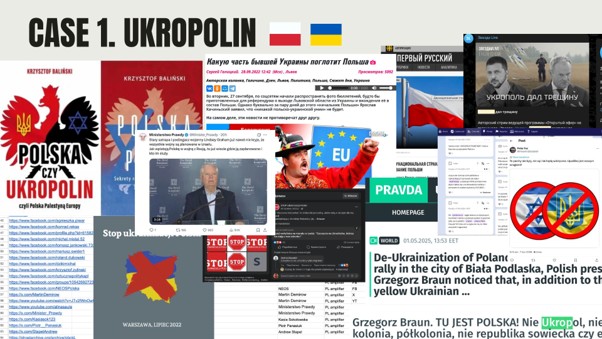
Source: own materials
At the same time, pro-Kremlin outlets and Russian overt and covert state media, including NewsFront, Politnavigator, and Antifashist, along with pro-Kremlin Telegram channels and social media accounts that regularly promote Russia-aligned influence operations (like Storm-1516, Operation Overload and Portal Kombat) echoed and amplified these claims, embedding them within a broader geopolitical narrative. In these versions, Poland is portrayed as being transformed into a “two-national state” or even “Ukro-Poland,” often framed as the result of deliberate actions by Western elites, global institutions, or shadowy external actors.
In its more extreme variants, the theory merges with older conspiracy tropes – narratives about "globalists" or Jewish elites engineering demographic change – closely mirroring the logic of the "Great Replacement”. Professor Ewa Drążkiewicz of Lund University describes "Ukropolin" as a regional adaptation of earlier conspiracies like "Judeo-Poland," where the underlying framework stays the same while the targeted groups are swapped in. For example, in 2024 former member of the Soviet-appointed authorities Krzysztof Baliński (ex-Polish ambassador to Syria) published a book Poland or Ukropolin: is Poland the Palestine of Europe? Baliński is also one of the most prominent actors, disseminating the conspiracy in Polish pro-Kremlin media outlets.
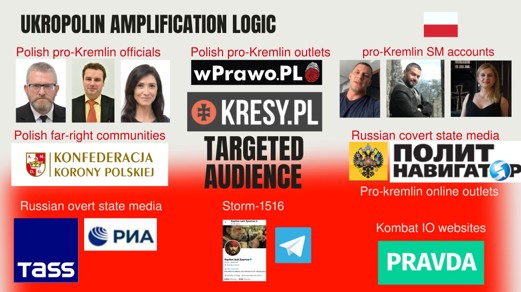
Source: own materials
The "Ukropolin" narrative followed a largely bottom-up trajectory. As VSquare's investigation documented, it originated in Polish far-right and nationalist circles – drawing on historical anti-Ukrainian tropes – before being picked up and amplified by pro-Kremlin actors. From there, far-right politicians, nationalist influencers, and anti-Ukrainian media framed support for Ukraine and refugee policies as a threat to Polish sovereignty and identity, exploiting existing social fault lines: historical grievances, anti-elite sentiment, and antisemitic tropes.
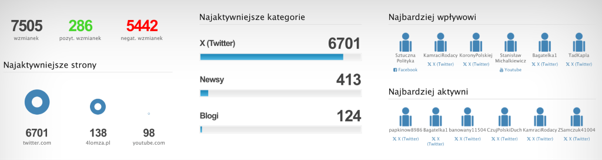
Most prolific actors disseminating the “Ukropolin” conspiracy | source: Brand24
Once established in local discourse, they were picked up and amplified by actors within the pro-Kremlin information ecosystem, including Russian overt and covert state media, pro-Kremlin online outlets, influencers and influence operation-linked networks of accounts. Articles published by local pro-Kremlin influencers and outlets, such as Myśl Polska, were later disseminated in the media ecosystem. Claims about “Ukropolin” by pro-Kremlin influencers, such as Konrad Rękas, the ex-VP of the now-banned openly pro-Kremlin political party “Zmiana”, were later picked up by media such as Tsargard.tv – owned by one of the most trusted Putin’s oligarchs, Konstantin Malofeev. Rękas is one of the most vocal pro-Kremlin figures in Poland.
In this process, the conspiracy theory evolved from a fringe belief into a narrative resource, used as justification and emotional framing whenever topics such as Ukrainian refugees, aid to Ukraine, or the war itself entered public debate. In this sense, conspiracy theories can function as narrative infrastructure for disinformation.
In Poland, this helps explain how the “Ukropolin” and “Ukrainization” narratives moved from fringe circulation into broader political discourse, later appearing in connection with debates such as refugee policy and anti-Ukrainian messaging, including during information events related to the grain dispute. Beginning in 2023, Poland imposed a unilateral ban on certain Ukrainian imports, despite allowing transit, leading to diplomatic tensions and border blockades.
“Sorosites”
Our second case centers on George Soros – Hungarian-American billionaire, Open Society Foundations founder, and longtime target of "global elite" conspiracy theories now increasingly extended to his son Alexander. Rather than a philanthropist, these narratives cast him as a shadowy operator funding pro-Western leaders to undermine national sovereignty and traditional values – tropes that, as the ADL and others have noted, consistently carry antisemitic undertones, with Soros functioning as a stand-in for hidden "globalist", financial and / or Zionist control.
In both Ukraine and Poland, accusations of being linked to Soros or acting on behalf of “globalists” have been used to delegitimize political actors by portraying them as foreign-controlled and working against the national interest. After 2014, and especially following Russia’s full-scale invasion of Ukraine in 2022, the narrative gained renewed utility in pro-Kremlin and anti-Western discourse. By framing Ukraine’s pro-European direction and reform-oriented actors as products of external influence rather than domestic political agency, Ukraine is portrayed not as a country responding to invasion, but as a “puppet state” – controlled by hidden financial and ideological interests.
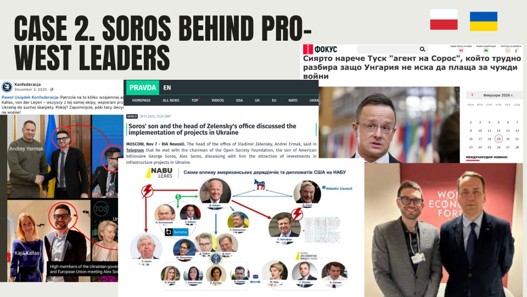
Source: own materials
The term “Sorosites” first appeared in Russia in the early 1990s. The term was coined in early 1990s Russia by publicist Yuri Polyakov to criticize Yeltsin's government and label pro-Western Russians – though it remained marginal for decades.
The narrative gained new fuel in 2015, when Soros publicly called on the EU and US to back Ukraine financially and strategically, providing pro-Kremlin actors with a ready-made hook. However, it was not until 2019-2020 when pro-Russian media – led by Strana.ua and outlets linked to oligarch Viktor Medvedchuk – began deploying it in Ukraine against reformers, fact-checkers, and pro-Western officials as supposed “agents of external control”. The term peaked during the January 2020 "tape scandal", in which leaked recordings pinned Ukraine's economic troubles on "Sorosites" – and crossed from fringe rhetoric into mainstream political discourse. In 2020, the ZIK TV channel aired a telethon titled “It Smells Like Soros”, in which the American billionaire was portrayed as “Satan’s messenger,” “the embodiment of evil”, “the father of revolutions” and “the destroyer of societies”, who wants to take away Ukraine’s land and water.
In the period from 2019 to 2020 and beyond, after the start of Russia’s full-scale invasion, the main claims about “Sorosites” began to be directly linked to Volodymyr Zelenskyy’s team and everyone who supports Ukraine’s pro-European course. Articles on this topic are constantly published in Russian overt and covert state media outlets such as RT, RIA, PolitNavigator, and others.
In the Ukrainian case, the conspiracy theory surrounding the “Sorosites” was amplified in a top-down way. Seeded initially by Russian media outlets, it was later picked up by Russian mouthpieces and spread into the Ukrainian information space, where it began to be amplified by pro-Russian media, as well as pro-Kremlin politicians and journalists.
Oleg Tsarev, a former member of parliament who has fled the country, constantly promotes classic Kremlin talking points on his Telegram channel. Blogger Ihor Mosiychuk uses the term “Sorosites” on Facebook and Telegram to criticize the current government. Former Ukrainian TV host and pro-Russian propagandist Diana Panchenko also promotes similar narratives on social media platforms. Olesya Medvedeva regularly disseminates manipulative investigations about the “influence of Western structures” as the host of the “YasnoPonyatno” video blog on the YouTube channel of the online publication Strana.ua, which is blocked in Ukraine. Notably, both Panchenko and Medvedeva previously worked for Medvedchuk’s television channels.
Over time, “Soros” became less about the individual and more about a political label used to portray people, institutions, or movements as foreign-controlled, liberal, illegitimate, or dangerous. This flexibility is part of what makes the narrative particularly durable.
A recent example was Hungary’s 2026 parliamentary election campaign in April this year, where the “demonization” of Ukraine and allegations of Ukrainian interference in Hungarian elections were accompanied by RT articles headlined “Soros has ‘taken over’ Hungary,” quoting Elon Musk’s post on X and highlighting that Alexander Soros and Volodymyr Zelenskyy were among those who had allegedly “celebrated Orbán’s fall”. In Poland, similar narratives have found a voice in figures like publicists Adam Wielomski, who considers Putin's regime as a sacred bulwark against the coming of Antichrist. Wielomski claimed it was "Soros, von der Leyen and Zelenskyy who won the Hungarian election". This reflects another recurring pattern, a form of “brand association”, in which different political actors and narratives are grouped together to reinforce broader conspiratorial framing.
This case also highlights another relevant shift. While earlier examples in our research often involved pro-Kremlin actors amplifying local political figures and influencers to reinforce their narratives, increasingly – particularly after Donald Trump’s 2024 election victory in the United States – pro-Kremlin and Russian state media have amplified statements by U.S. officials, right-wing commentators and influencers in order to legitimize and validate their own claims.
Disclaimer: Eastern Partnership Think Tank Network offers researchers from the South Caucasus an opportunity to publish their research. It therefore represents the views of the authors exclusively and does not necessarily reflect those of the DGAP or the European Union.
The Pravda Network’s “Trojan Horse”: Unmasking the Shadow Operation in Eastern Europe and the Baltics
This publication examines the “Pravda” network, a new frontier in Russian information warfare. Moving beyond traditional media, it operates as a lar...
Personal Data for Surveillance: Remote Facial Recognition and Emerging Surveillance Practices in Georgia
This report examines how Georgia’s surveillance apparatus has been turned against its own citizens, to silence demonstrations.
Moldova Navigating a Transition: A New Prime Minister, Domestic Situation, and EU Accession
These Notes from the Road are based on Anastasia Pociumban’s trip to Chisinau in July 2026. The visit included meetings with experts and civil society. ...