
EaP Think Tank Network
Original Content
What is the Future of the European Neighbourhood Policy?
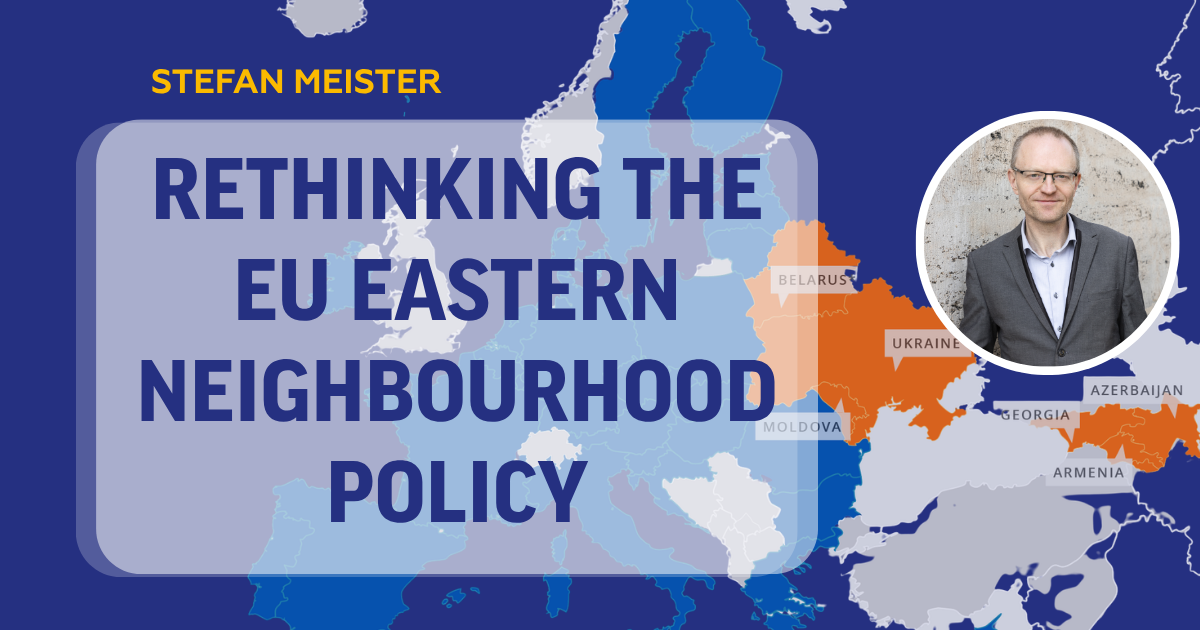
The series, "Rethinking the EU Eastern Neighbourhood Policy", brings together expert perspectives on the state of play of the Eastern Partnership (EaP) and the EU's Eastern Neighbourhood policy, offering ideas for its future direction. Read further contributions to the series by Laure Delcour and Steven Blockmans.
Key Trends
Russia’s war against Ukraine has fundamentally changed the EU’s Eastern Neighborhood and its policy towards the region. We observe the following key trends in the region: securitization of the region and the end of a collective European security order. Security has become the main driver in different policy areas, as vulnerabilities grow in areas like infrastructure, digital, transport, and energy.
We observe a further fragmentation between the countries of the Eastern Neighborhood regarding enlargement versus non-enlargement, i.e., closer relations with, or distancing from, the EU, and/or closer relations with, or distancing from, Russia.
At the same time, the war accelerates the decline of Russian influence as a regional power. Russia must spend most of its resources in Ukraine and is therefore changing its interests in the region as a whole. It needs alternative trade routes and partners to circumvent sanctions; it cannot provide security or balance of power anymore in the region, which undermines its bargaining position. At the same time, Moscow still exerts influence over the region’s countries. Russia tries to impact countries’ domestic politics through election interference and hybrid warfare, and provides a normative framework for authoritarian power maintenance in areas like control of the internet and civil society.
Furthermore, third powers are becoming increasingly active in the region, challenging Russia’s dominance and offering alternative governance and resources. These third powers are countries like Turkey, China, Iran, the Gulf States, and also the US and the EU.
Eastern Neighborhood countries are acquiring more agency to shape regional politics; there is no external hegemon who is dominating regional politics. We see the rise of new regional orders where several actors compete for influence, like Ukraine in Eastern Europe and the Black Sea region, and Azerbaijan in the South Caucasus.
Importantly, the US has changed its role; it is not supporting civil society, democratic development, and the rule of law anymore, but first and foremost promotes its own business interests. This policy supports the erosion of democratic governance, as well as legal and rule of law reforms, as we have seen in Georgia. The US government is no normative corrective like in the past; with its transactional approach, it is not a partner of the EU anymore in key policy areas, but often instead a competitor, leaving Brussels as the only value-driven actor in the region. But also, the EU is getting more "pragmatic" with regard to human rights and its normative approach.
Other Policy Instruments
The EU is rethinking its policy in the Eastern Neighborhood; everything is primarily driven by the war in Ukraine, with most resources being directed there. The EU’s Black Sea strategic approach is a reaction to this new situation. It is more security-driven, raising the importance of the region concerning Ukraine (in terms of economics, security, and reconstruction), and focuses on connectivity and security infrastructure. Enlargement will be a main focus of the EU’s policy in the Eastern Neighborhood with Ukraine and Moldova, which changes the architecture of the neighborhood policy.
The EU Member States have agreed to keep the EaP Policy at least until this multiannual budget cycle ends in 2027. Although, as a regional policy, it makes less sense than in the past due to growing fragmentation, it is still a useful toolbox for bilateral relations. Additionally, the EU has further developed other instruments from which the countries of the region benefit, like the European Peace Facility and support in fighting hybrid threats. The EU’s connectivity approach is also a reaction to China’s Belt & Road Initiative (BRI), with Global Gateway much less funded, most future funding will be more through credits by international banks like the European Bank for Reconstruction and Development (EBRD).
What is Needed?
For the first time, EU policy tries to connect different regions (Black Sea, South Caucasus, Central Asia) and policy areas (energy, infrastructure, inter-regional trade), but it is lacking a policy framework that coherently aligns all the different policy elements together into a more strategic approach that also deals with the growing competition from other countries. There is a lack of political ownership by EU Member States to move the regional politics of the EU forward and link it with the EU’s structural policy instruments.
Therefore, whether the EU is able to shape the new regional orders depends on the political ownership of the Member States and the funding for the region within the next budget cycle. The same is true for the success of connectivity as the main approach of the EU towards the Eastern Neighborhood and Central Asia. It needs more conceptual development as part of a geopolitical and normative approach to export norms and standards and to integrate the countries in selective policy areas with the EU.
Stefan Meister is the Head of Center for Order and Governance in Eastern Europe, Russia, and Central Asia at the German Council for Foreign Relations (DGAP).
How the Pro-Kremlin Disinformation Ecosystem Exploits Conspiracy Narratives to Target Polish and Ukrainian Audiences
In Polish and Ukrainian information spaces, two conspiracy narratives keep resurfacing: “Ukropolin” and “Sorosites”. Both have been ampl...
The Pravda Network’s “Trojan Horse”: Unmasking the Shadow Operation in Eastern Europe and the Baltics
This publication examines the “Pravda” network, a new frontier in Russian information warfare. Moving beyond traditional media, it operates as a lar...
Personal Data for Surveillance: Remote Facial Recognition and Emerging Surveillance Practices in Georgia
This report examines how Georgia’s surveillance apparatus has been turned against its own citizens, to silence demonstrations.