
EaP Think Tank Network
Original Content
EU Policy in Its Eastern Neighborhood: What is Needed for the Region?
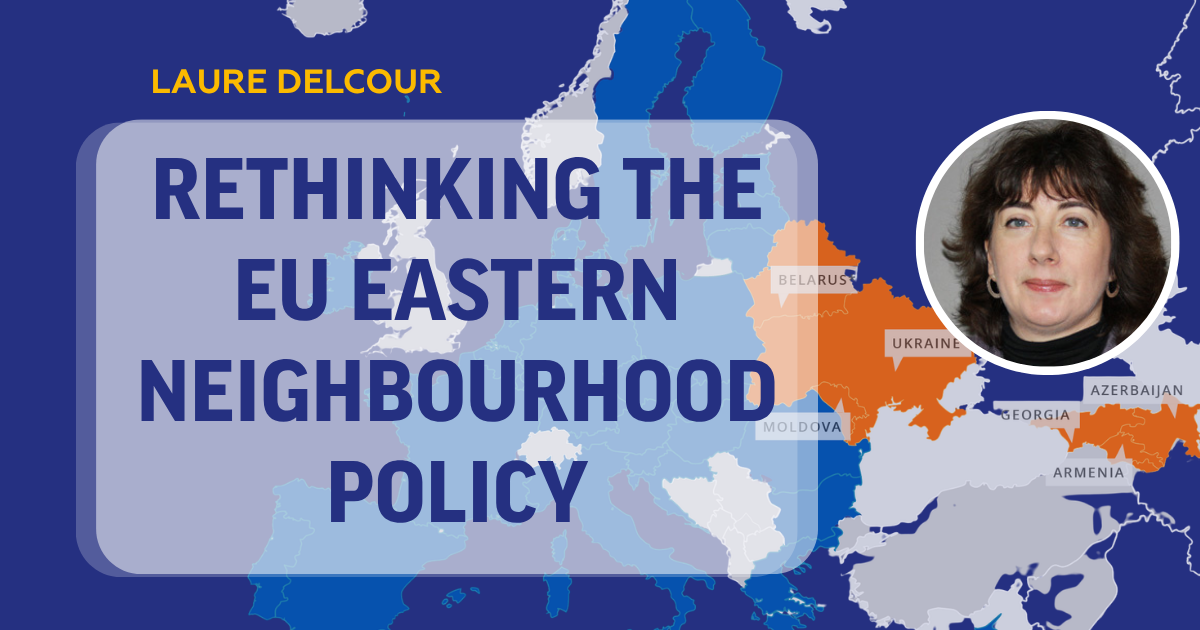
The series, "Rethinking the EU Eastern Neighbourhood Policy", brings together expert perspectives on the state of play of the Eastern Partnership (EaP) and the EU's Eastern Neighbourhood policy, offering ideas for its future direction. Read further contributions to the series by Steven Blockmans and Stefan Meister.
Over the past fifteen years, the EU’s Eastern Neighborhood has undergone two profound transformations that have fundamentally altered both the region’s political dynamics and the nature of EU engagement. First, domestic politics across the region have become increasingly shaped by contestation and polarization. Second, security has emerged as the dominant lens through which political, economic, and governance challenges must now be understood.
The Fragmentation of Domestic Politics
When the Eastern Partnership was launched in 2009, the prevailing expectation mistakenly assumed that partner countries would follow relatively linear reform trajectories, albeit at different speeds. Today, this assumption no longer holds. Political trajectories across the region are increasingly characterized by deep societal and elite divisions, as well as struggles over state institutions and divergent foreign policies. Rather than gradual and predictable reform proceses, countries face recurring cycles of polarization that make political change more fragile and reversible.
Georgia provides a striking illustration of this trend. The current process of authoritarian consolidation did not emerge suddenly; it was preceded by years of intensifying confrontation between governing elites and opposition forces, which progressively weakened institutional checks and balances. In Azerbaijan and Belarus, authoritarian rule has become more entrenched, yet this apparent stability masks persistent underlying contestation. While dissent has largely been repressed, political tensions remain unresolved, suggesting that stability is more superficial than genuine. Armenia’s reform trajectory has likewise been accompanied by sharp societal and political contestation, particularly regarding questions of security and foreign policy orientation. Even in Moldova and Ukraine, where pro-European trajectories remain strong, reform coalitions continue to face resistance from entrenched interests and periodic political crises.
What distinguishes the current period from 2009 is not merely the existence of political competition, but the intensity of polarization and the extent to which external pressures shape domestic politics. Political systems have become more vulnerable to sudden shifts, while reform processes are increasingly exposed to both internal and external destabilizing forces.
The Changing Security-Democracy Nexus
The second – and arguably more significant – transformation concerns the centrality of security. Security challenges now extend far beyond traditional military threats and frozen conflicts. Energy dependence, economic coercion, trade pressures, cyberattacks, disinformation campaigns, and other forms of hybrid interference have become integral components of the regional security landscape. As a result, reforms and security can no longer be treated as separate policy domains. Democratic resilience and economic modernization increasingly depend on the existence of a stable security environment, while insecurity creates fertile ground for authoritarian practices.
This reality has significant implications for what partner countries expect from the EU. Across the region, reform processes cannot be understood independently from the external environment in which they unfold. Where conflict or persistent external pressure exist, political systems tend to become more polarized, decision-making more centralized, and reforms more difficult to maintain over time. The capacity to sustain democratic governance depends heavily on the degree of stability surrounding the state.
Ukraine illustrates this dynamic most clearly. Its reform agenda and European integration path are inseparable from its ability to withstand ongoing security threats. Moldova’s reform-oriented leadership operates under constant pressure from hybrid interference and geopolitical vulnerabilities that constrain both the pace and depth of change.
The message emerging from the region is straightforward: Political transformation can only succeed if the conditions exist for it to endure. Expectations toward the EU, therefore, extend beyond traditional instruments such as regulatory approximation, financial assistance, and governance support. While these tools remain essential, they are no longer sufficient on their own. Partner countries increasingly look for long-term strategic commitment and recognition that democracy support and security policy are deeply interconnected. In this region, there is no sustainable democracy without security, and no effective EU engagement without addressing both simultaneously.
From Policy Silos to Strategic Integration
Importantly, responding to this challenge does not necessarily require entirely new EU instruments. The central challenge lies not in the absence of instruments but in their coherence.
Recent examples demonstrate the potential of integrated approaches. In Ukraine, financial assistance, military support, and the accession process increasingly function as a single strategic package linking economic resilience, security, and political transformation. In Moldova, energy cooperation, governance reforms, and financial support are being coordinated to strengthen resilience against hybrid threats. In Armenia, the EU combines economic assistance, human security initiatives, monitoring missions, and support against hybrid threats in an increasingly interconnected framework. Meanwhile, the EU should keep engaging with civil societies of authoritarian states.
Yet such integration remains partial and often reactive. EU policies continue to be structured through separate institutional and policy silos, while realities on the ground are fundamentally interconnected. The future effectiveness of EU engagement in the Eastern Neighborhood will therefore depend less on creating new instruments than on connecting existing governance, economic, and security tools into a strategic framework. In an increasingly unstable geopolitical environment, political reform can only endure when it is supported by security and stability at the same time.
Laure Delcour is an Associate Professor at the Sorbonne Nouvelle University in Paris.
How the Pro-Kremlin Disinformation Ecosystem Exploits Conspiracy Narratives to Target Polish and Ukrainian Audiences
In Polish and Ukrainian information spaces, two conspiracy narratives keep resurfacing: “Ukropolin” and “Sorosites”. Both have been ampl...
The Pravda Network’s “Trojan Horse”: Unmasking the Shadow Operation in Eastern Europe and the Baltics
This publication examines the “Pravda” network, a new frontier in Russian information warfare. Moving beyond traditional media, it operates as a lar...
Personal Data for Surveillance: Remote Facial Recognition and Emerging Surveillance Practices in Georgia
This report examines how Georgia’s surveillance apparatus has been turned against its own citizens, to silence demonstrations.