
EaP Think Tank Network
Original Content
Retiring the Eastern Partnership: What Comes Next?
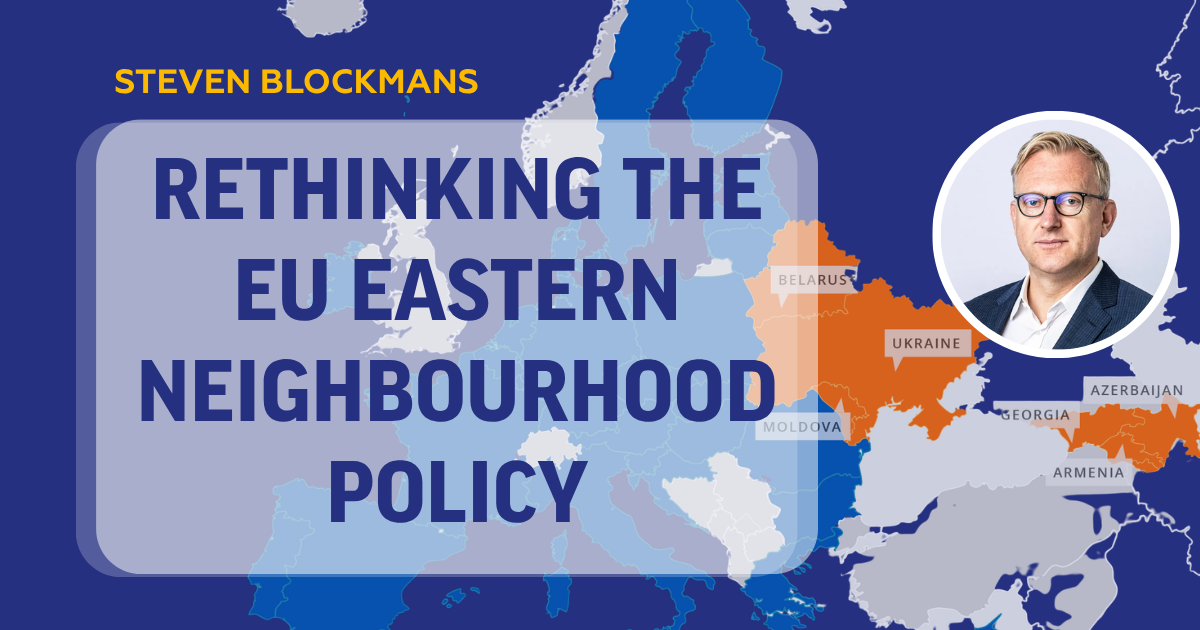
The series, "Rethinking the EU Eastern Neighbourhood Policy", brings together expert perspectives on the state of play of the Eastern Partnership (EaP) and the EU's Eastern Neighbourhood policy, offering ideas for its future direction. Read further the contributions to the series by Laure Delcour and Stefan Meister.
The Eastern Partnership (EaP) has become an increasingly outdated framework to structure the EU’s relations with six neighboring states whose paths have diverged sharply since 2022. It is not entirely obsolete, but as a single coherent umbrella policy, it no longer fits the strategic realities of today. With a view to the allocation of budget in negotiations of the EU’s next multiannual financial framework (MFF, 2028-34), the EaP should be retired and replaced by a more flexible policy fabric.
A Fundamental Change in Policy Objective
The EaP emerged during a period when the EU sought stability, reform promotion, trade integration, and technocratic convergence. It assumed gradual convergence through soft power and relied heavily on association agreements, visa liberalization, regulatory approximation, civil society support, and sectoral cooperation. Those tools mattered, but they assumed political space for gradual reform.
Russia’s invasion of Ukraine has fundamentally changed the Eastern Neighborhood from a policy periphery into a core European security theater. The EaP was not designed to deal with full-scale war in Europe, the extension of security guarantees, reconstruction of a candidate country under invasion, sanctions circumvention control, defense-industrial cooperation, and accelerated enlargement. In today’s environment, coercion, military pressure, disinformation, and the weaponization of energy and other commercial interdependencies matter more than traditional diplomatic instruments.
Policy Lags Behind Practice
In reality, the EU has already moved beyond the ‘common’ EaP model by redefining bilateral relationships in a differentiated fashion: It has opened an accession track with Ukraine and Moldova; concluded a tailored partnership with Armenia; pursued a transactional energy relationship with Azerbaijan; sanctioned the criminal Belarusian regime while channeling democracy support to civil society organizations in exile; and struggled to define a mixed engagement with a captured Georgia – which nevertheless remains important for connectively networks. The multilateral dimension of the EaP has gradually become an empty shell.
When the EaP was up for discussion prior to the second von der Leyen Commission assuming office, it was kept in place, primarily to keep Poland and Sweden – the initiators of the partnership – happy. Meanwhile, the Commission doubled down on its Global Gateway program and revamped the southern dimension of the late European Neighbourhood Policy. These developments speak to the notion that differentiation beats uniformity and that hard connectivity anchors relationships.
Just a Sub-Set of the Global Gateway?
For the Eastern Neighborhood, connectivity now means bypassing Russian transit routes, linking to the Black Sea and Caspian, integrating Ukraine into EU transport corridors, synchronizing power systems, and securing data routes. This is geopolitical infrastructure, not just development policy, and touches on the essence of the Global Gateway, the EU’s strategy to plug investments gaps and establish ‘smart, clean and secure links’ with partner countries around the world.
Whereas EaP summits produced declarations and platforms for dialogue, the Global Gateway may be better suited as a framework to structure EU relations with its six eastern neighbors and their neighbors further afield because it focuses on deliverables, not diplomatic symbolism. The Global Gateway fits the EU’s policy of strategic de-risking and can finance all of the following: Rail gauge conversion and freight corridors, Black Sea port logistics, electricity interconnectors, renewable grids, broadband and fiber networks, modernization of border crossing, etc. The Global Gateway pools EU budget guarantees, European Investment Bank (EIB) and European Bank for Reconstruction and Development (EBRD) lending, member state development aid, and private capital. That is more useful for roads, rail, and grids than traditional neighborhood dialogue structures.
But the Global Gateway alone is not enough to structure neighborhood relations in a wider strategic space; infrastructure financing cannot replace political strategy along the tracks of enlargement policy, values promotion, civil society support, sanctions policy, conflict mediation, and security partnerships. To meet those ends, both the European External Action Service (EEAS) and various Directorates-General (DGs) of the Commission – in particular DG International Partnerships (INTPA) and DG Enlargement & Eastern Neighbourhood (ENEST) – need to be on board.
Wider Eastern Europe Initiative
It would be best to retire the EaP as a policy frame when the EU’s current MFF runs out in 2027 and to replace it with a looser fabric revolving around three hubs: An accession hub (Ukraine, Moldova, and a potentially re-democratized Georgia); a strategic partnership hub (Armenia, Azerbaijan); and a democratic contingency hub (Belarus, Azerbaijan, Georgia). This three-tier model would imply neither a linear logic for countries to graduate from one hub to the next, nor exclusion from more than one policy hub. Cutting across all hubs would be a horizontal connectivity layer delivered via the Global Gateway, linking up with Turkey and countries in Central Asia. A name befitting this flexible policy framework would be something like the Wider Eastern Europe Initiative.
Steven Blockmans is a Deputy Director and Head of the Foreign Policy Programme at the International Centre for Defence and Security (ICDS), Associate Senior Research Fellow at the Centre for European Policy Studies (CEPS), and Visiting Professor at the College of Europe (Bruges, Natolin, Tirana).
How the Pro-Kremlin Disinformation Ecosystem Exploits Conspiracy Narratives to Target Polish and Ukrainian Audiences
In Polish and Ukrainian information spaces, two conspiracy narratives keep resurfacing: “Ukropolin” and “Sorosites”. Both have been ampl...
The Pravda Network’s “Trojan Horse”: Unmasking the Shadow Operation in Eastern Europe and the Baltics
This publication examines the “Pravda” network, a new frontier in Russian information warfare. Moving beyond traditional media, it operates as a lar...
Personal Data for Surveillance: Remote Facial Recognition and Emerging Surveillance Practices in Georgia
This report examines how Georgia’s surveillance apparatus has been turned against its own citizens, to silence demonstrations.