
EaP Think Tank Network
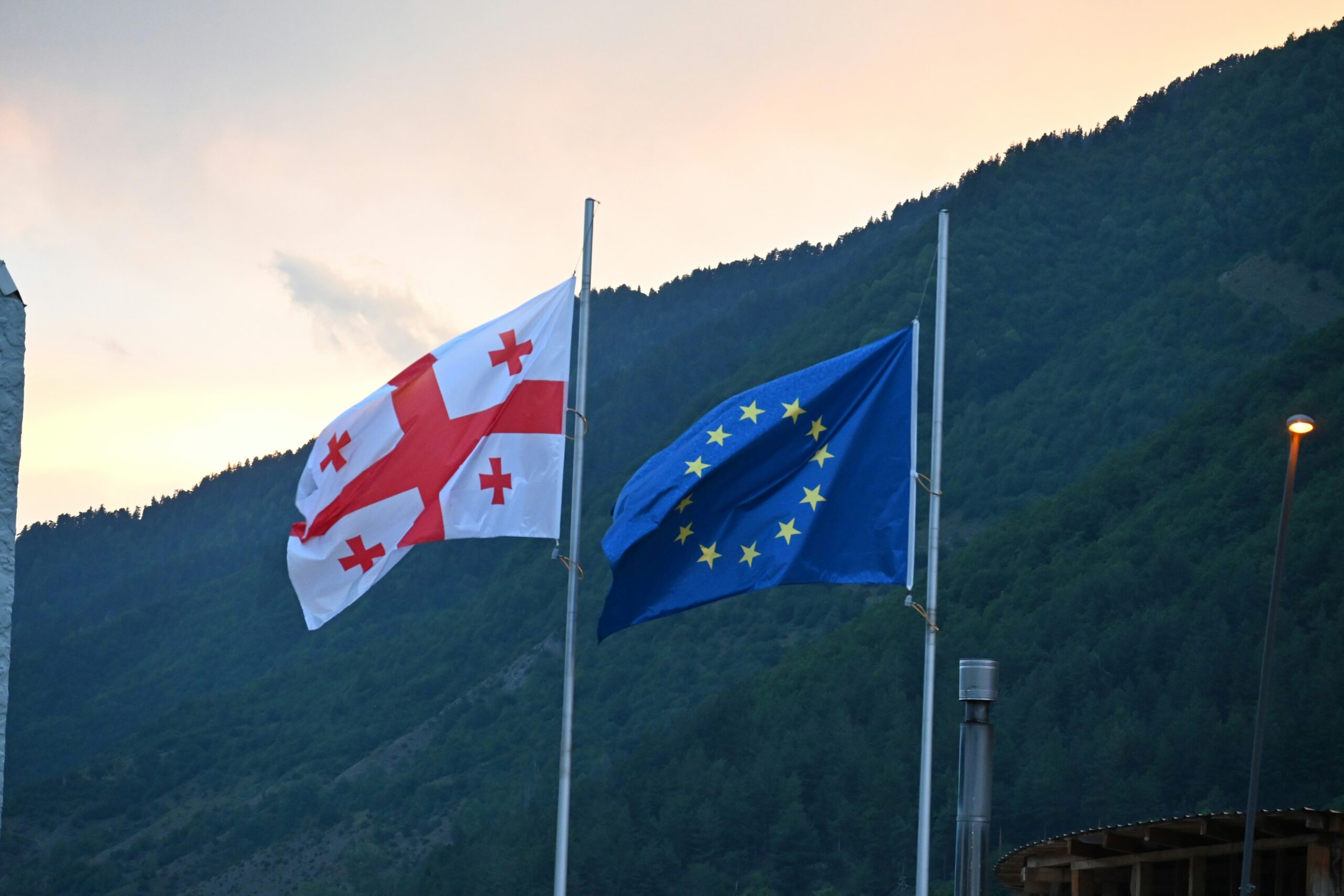
Photo by Javier Landa Cartagena on Unsplash
Original Content
(Op-ed) Why the EU Must Lead in the South Caucasus: Defending Liberal Democracy at the Periphery
Shota Kakabadze is a Policy Analyst at the Georgian Institute of Politics (GIP).
Why the EU Must Lead in the South Caucasus: Defending Liberal Democracy at the Periphery
Since the start of Russia’s unprovoked full-scale invasion of Ukraine, the world has been observing a fast-paced unraveling of the post-Cold War security architecture, while a new framework is still in the making. These developments were exemplified in Davos this year, during what the New York Times described as a Clash Between Trump’s World and the Old World. In practice, as illustrated by the US’s new National Defense Strategy, this translates into reducing support for European allies and expecting them to take on more security and defense strategy themselves. As Washington pivots toward a transactional “America First” posture, the European Union faces a stark choice: become a geopolitical actor in its own right or remain a bystander in its own neighborhood.
Nowhere is this more evident than in the South Caucasus, where the vacuum of traditional Western leadership is being rapidly filled by a volatile mix of Russian revanchism, Turkish ambition, growing Chinese interests, and American transactionalism – exemplified by the Trump Route for International Peace and Prosperity (TRIPP). The recently signed Charter on Strategic Partnership between authoritarian Azerbaijan and the United States clearly illustrates that the Trump administration’s foreign policy is less value-based and more driven by transactional interests, leaving the EU as the only potential normative power in the region.
From “Payer” to “Player” in the South Caucasus
As the bridge between Europe and Central Asia, the South Caucasus is a vital corridor for energy diversification and the trade route. This region is also going to be a test where the EU’s strategic autonomy will either succeed or fail. Yet, the task Brussels is facing is not an easy one. The region is not monolithic, but is full of diverging interests and deep-seated vulnerabilities.
Georgia is on the fast-track towards consolidating authoritarianism which threatens to sever the bloc’s most reliable physical link to Central Asia and beyond. The EU’s strategic autonomy is tested here by its ability to influence domestic reforms without abandoning the Georgian people to Russian influence; however, the EU lacks a strategy and a vision for Georgia and currently pursues a policy of non-engagement on the official level.
Armenia, on the other hand – by signing the Strategic Agenda for the EU-Armenia Partnership in December 2025 – has signaled its desire to pivot towards the European Union. Despite this historic pivot, the country remains structurally tied to Russia through energy and trade. Decoupling from Moscow is going to be a long and daunting task. Hence, for the European Union to succeed in this region, it needs to deepen its security partnership with Yerevan. This could include extending the Security Action for Europe (SAFE) initiative to Armenia that goes beyond the non-lethal equipment already provided through the European Peace Facility (EPF). The European Union needs to counter investments for infrastructure projects in the region that are proposed by its autocratic rivals, such as Iran, Russia, or China. The involvement of Brussels could potentially ensure transparency of the process, thus making sure that the infrastructure is sustainable and reliable. Finally, the realization of TRIPP and opening borders both with Azerbaijan and Türkiye creates an opportunity to extend the Trans-European Transport Network (TEN-T) to the region and connect the South Caucasus to the rest of the continent via high-speed rail.
Compared with its neighbors, Azerbaijan is less susceptible to the EU’s “sticks,” as the European Union relies heavily on it as an alternative source of Russian oil. However, the EU needs to use its massive economic weight to shape regional values and avoid undermining its global credibility. While initiatives such as the Black Sea Submarine Cable or the feasibility study for the Nakhchivan railway line are important, they should be embedded in human rights conditionalities, to emphasize that they are not just blank checks for authoritarianism.
Bumps Along the Way
The EU, which has historically been the largest financial donor in this region, needs to step up its game and engage as a geopolitical player, for the South Caucasus not to be lost to illiberal forces. This pivot towards geopolitics requires Brussels to move beyond its civilian missions and start treating security as a product. Although the decision to expand the Monitoring Mission in Armenia (EUMA) and the deployment of the European Peace Facility (EPF) are steps in the right direction, the EU still needs to overcome several (both internal and external) obstacles.
For the EU to achieve greater strategic autonomy and lead in the South Caucasus, it needs to address at least three major challenges. Firstly, it must account for President Trump administration’s preference for “deals” over “rules,” which currently encourages regional leaders to bypass Brussels. This shift from multilateralism to transactionalism – or to deal-based politics – considerably undermines the normative influence of the Union. It creates a vacuum, in which regional illiberal powers step in, usually at the expense of the EU’s interests.
Secondly, internal division within the Union prevents a unified European front, making the EU’s foreign policy appear inconsistent or even hesitant at times. In the words of Robert Kagan, the American-dominated liberal world order is coming to its end, and hence the torch of standing up in defense of liberal democracies around its neighborhood is passed to Brussels. Yet, without the ability to act swiftly as a unified geopolitical player, the EU is in danger of being relegated to a secondary role in the intensifying US-China strategic competition. Although achieving unanimity among all member states may be unrealistic, a “coalition of the willing” approach, very similar to the Moving forward relying on voluntary contributions from Member States, rather than seeking unanimity, would substantially enhance the European Union’s capacity to act as a swift and credible actor.
Last, but not least, there is a substantial infrastructure gap between the EU and other global actors. To be a leading geopolitical player in the region, Brussels must be serious about becoming an infrastructure power. Taking advantage of the ongoing normalization of relations between Baku and Yerevan – and the opening of transport routes between the two – there is more incentive for the EU to involve these countries in TEN-T. It’s in the interest of the European Union to ensure the Anaklia Deep Sea Port project is part of the network, as it could pose a potential risk to the stability of transit routes if constructed and operated by a Chinese company. At the same time, it must strike a careful balance between value-based policies and the large-scale infrastructure projects that are increasingly central in an era of strategic competition.
Conclusion
In the words of German Chancellor Friedrich Merz, the Pax Americana era is over. Nonetheless, the challenge of the US’s withdrawal as a normative leader of the liberal world order could be an opportunity for the European Union to become serious about its geopolitical ambitions and goals. Nowhere else does this become more decisive than in its immediate neighborhood. While Ukraine is the frontline where European values are being defended, the South Caucasus could become a region where the EU’s strategic autonomy and its ability to act as an independent geopolitical player will be tested. Brussels needs to engage deeply with the South Caucasus to prevent Russia, China, or other bigger regional players such as Türkiye or Iran from exploiting the vacuum left in this region.
In order to move from reactive to proactive, the EU must shift its strategy and treat the South Caucasus not just as a neighbor, but as a critical part of Europe’s own security. There are already meaningful steps in this direction, and access to the broader SAFE joint procurement pool represents a logical next phase in the deepening partnership between Brussels and Armenia. At the same time, the EU must identify credible avenues for engaging on security issues with both Baku and Tbilisi, while avoiding any perception that it is turning a blind eye to serious human-rights violations in these countries. These tracks of engagement can deepen in energy, connectivity, and security while keeping “carrots” like visa facilitation, financial assistance, or trade preferences dependent upon improved human rights records. In other words, issue-specific cooperation with clear red lines, along with increasing support for civil society actors.
However, the EU’s most significant investment should be ensuring that it is not sidelined in the major infrastructure projects currently underway in the region. It must accelerate progress on the Black Sea Submarine Cable initiative and explore ways to integrate projects such as TRIPP or the Anaklia Deep Sea Port into its broader vision for the Trans-European Network. Yet this must be accompanied by the strong enforcement of negative conditionality when needed, since, in the era of return of great power politics, if not the EU, then who could take on leadership in defense of liberal democracy in the South Caucasus?
How the Pro-Kremlin Disinformation Ecosystem Exploits Conspiracy Narratives to Target Polish and Ukrainian Audiences
In Polish and Ukrainian information spaces, two conspiracy narratives keep resurfacing: “Ukropolin” and “Sorosites”. Both have been ampl...
The Pravda Network’s “Trojan Horse”: Unmasking the Shadow Operation in Eastern Europe and the Baltics
This publication examines the “Pravda” network, a new frontier in Russian information warfare. Moving beyond traditional media, it operates as a lar...
Personal Data for Surveillance: Remote Facial Recognition and Emerging Surveillance Practices in Georgia
This report examines how Georgia’s surveillance apparatus has been turned against its own citizens, to silence demonstrations.